


工商业光伏支架系统
BIPV 光伏系统
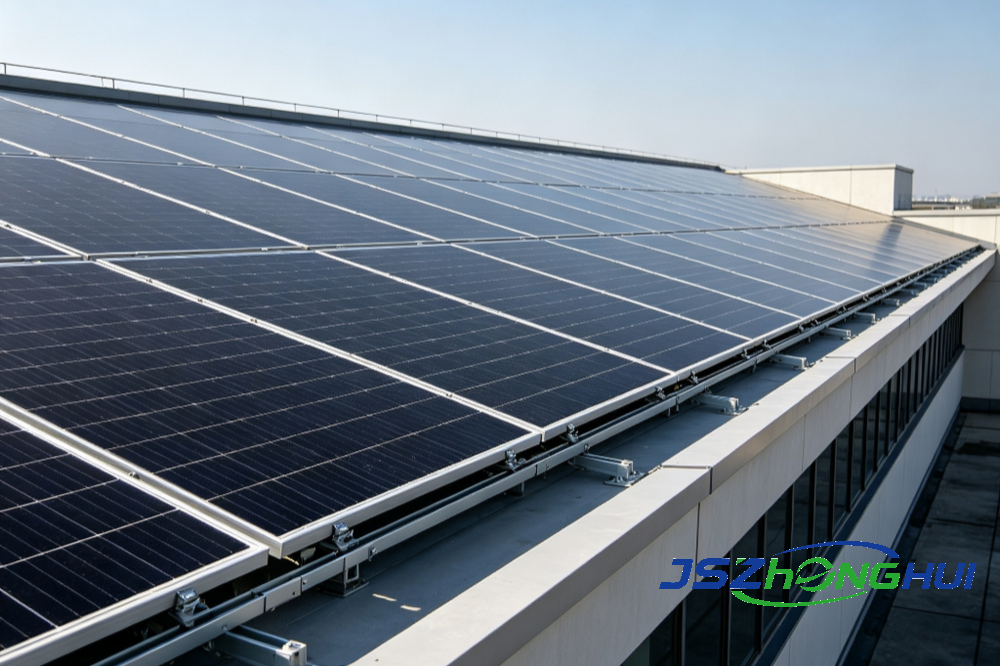
BIPV(Building Integrated Photovoltaic)工商业光伏系统是光伏建筑一体化的专业解决方案,将太阳能发电方阵直接作为建筑围护结构(屋面)的一部分。与传统的“支架+组件”在屋顶上加装的模式不同,BIPV系统直接替代常规彩钢瓦屋面,光伏组件既是发电单元,也是屋面的防水层和结构层,实现发电与建筑功能的一体化
核心参数:
参数 | 数值 |
材质 | 铝合金6063-T5/热镀锌钢 |
抗风荷载 | 50m/s |
雪荷载 | 1.5kN/m2 |
设计寿命 | 25年 |
质保 | 10年 |
核心优势:
全防水性能:采用专利结构性防水+密封条设计,形成三层或多重密封,杜绝渗漏隐患,不打胶、不贴胶,排水设计科学;
替代传统屋面:直接作为建筑屋面材料,节省传统彩钢瓦的采购和安装成本,经济性突出;
超长使用寿命:设计寿命25年以上,远超普通彩钢瓦(约10~15年),一次投资,长期收益;
轻量化设计:全铝或镀镁铝锌材质,重量约为常规全钢产品的三分之一,对屋面荷载小,适用范围更广;
设计创新:导轨顶面高于组件的设计,防积水防异物;充分考虑不同材料的电位差,避免电位腐蚀;
功能完备:满足建筑抗风压、气密性、水密性三大性能要求,兼具隔热防火、防震防水、运维便捷等优点。
适用场景:
新建钢结构厂房:BIPV系统直接作为屋面,替代传统彩钢瓦+后期加装光伏的方案;
旧厂房改造:直接拆除老旧彩钢瓦屋面,更换为BIPV系统,实现屋面翻新与光伏发电一举两得;
大型商业建筑、物流仓库、公共建筑屋顶;
关于荷载的补充说明:根据工程设计规范,混凝土屋面采用BIPV阵列式支架时,风压0.8~1.0kN/㎡地区新增光伏荷载约为1.5~2.0kN/㎡;风压0.5~0.8kN/㎡地区约为1.2~1.5kN/㎡。轻量化BIPV系统重量仅为常规全钢产品的三分之一,对屋面承重要求更低。
BIPV System
BIPV(Building Integrated Photovoltaic) commercial and industrial PV system is a professional building-integrated PV solution that makes the solar array part of the building envelope (roof) itself. Unlike the traditional "mounting + module" rooftop retrofit approach, a BIPV system directly replaces the conventional colored-steel roof: the PV modules serve both as power-generation units and as the roof's waterproofing and structural layers, integrating power generation with building functions
Core Parameters:
Parameter | Value |
Material | Aluminium alloy 6063-T5/Hot-dip galvanised steel |
Wind load resistance | 50 m/s |
Snow load | 1.5 kN/m² |
Design life | 25 years |
Warranty | 10 years |
Core Advantages:
Full waterproof performance: Patented structural waterproofing plus sealing-strip design forms three or more sealing layers, eliminating leakage risks; no glue or adhesive tape is used, and the drainage design is scientific;
Replaces conventional roofing: acts directly as building roof material,saving the procurement and installation costs of conventional colored-steel tiles, delivering outstanding cost-effectiveness;
Extra-long service life: design life of over 25 years, far exceeding ordinary colored-steel tiles (about 10–15 years); one-time investment with long-term returns;
Lightweight design: made of all-aluminium or Zn-Al-Mg material, weighing about one third of conventional all-steel products,exerting little load on the roof, with wider applicability;
Innovative design: the rail top surface is higher than the modules to prevent water and debris accumulation; potential differences between materials are fully considered to avoid galvanic corrosion;
Complete functionality: meets the three major building performance requirements of wind-pressure resistance, air tightness and water tightness, and also offers thermal insulation, fire protection, earthquake and water resistance, and convenient O&M.
Application Scenarios:
New steel-structure factory buildings: the BIPV system serves directly as the roof, replacing the traditional "colored-steel tile + later PV retrofit" approach;
Old factory renovation: the old colored-steel roof is removed and replaced with a BIPV system, achieving both roof renovation and PV power generation in one step;
Large commercial buildings, logistics warehouses, public buildings roofs;
Building façades: curtain-wall systems, exterior decorative façade systems, etc..
Supplementary notes on loads: according to engineering design codes, when a concrete roof adopts a BIPV array-type mounting system, the added PV load is about 1.5–2.0 kN/m² in areas with a wind pressure of 0.8–1.0 kN/m² and about 1.2–1.5 kN/m² in areas with a wind pressure of 0.5–0.8 kN/m². The lightweight BIPV system weighs only one third of conventional all-steel products, imposing lower load-bearing requirements on the roof.